The Gungarlin River camp was everything you want from a nights sleep in the high country — and then some. Woke up to fog so thick you couldn't see thirty metres across the valley. No alarm. No rush. The night before had dropped a lot of dew, so I wasn't even sure the campfire would cooperate, but I got it going. Coffee in hand, watched the fog burn off in layers until the whole valley opened up. Those mornings don't need much commentary.
This is Part 4 of the NSW High Country series — Kosciuszko and Cooleman Plains, 2026.
The Walk to Daveys Hut
Once the fog cleared we headed out on foot. Camp stayed put — I was thinking about staying another night after Dan left.
The trail follows the river flats for a stretch before climbing gently through open high country forest, then out onto open plains. Classic high country walking. Saw a few brumbies in the distance along the way.
Worth flagging: Daveys Hut is not the same as Davies Plain Hut. Different place. Easy to mix up on a map.
Daveys Hut history. Built around 1909 by a grazier named Tom Bolton, who moved in with his wife Mary a couple of years later and ran cattle through the surrounding country. It passed to Davey Williamson in 1935 — that's where the name comes from. National Parks resumed it in 1969 when grazing leases across the Kosciuszko region were being bought back. What's standing today is a weatherboard over timber frame structure, roughly 10 m × 6.5 m, stone chimney, and an iron roof laid over the original shingles to preserve them. Heritage listed. The Kosciuszko Huts Association carried out a solid round of restorations in 2012.
Two rooms. Bed frame. Old traps. Functional outdoor toilet. No water on site — there's a creek about a kilometre before the hut, which would've been a long walk every day when the place was occupied.
The track guide lists the walk as roughly 2 km one way. On the way back, Dan and I took a different route, ended up at the river and couldn't find a viable crossing. Climbed back up, worked along a ridge, looped around the long way. Total distance came out at 6.2 km with some proper elevation change thrown in. Legs were feeling it.
Brumby Cull Remnants
Before dropping back down to the river on the return, we came across the aftermath of a brumby cull — bones and skulls scattered through the scrub. Brumby numbers in Kosciuszko grew from around 1,700 in 2005 to over 20,000 by 2019, largely because active management stalled for years. Aerial shooting was approved in 2023. The current target is to bring numbers down to around 3,000 by mid-2027.
Gear: GME MT620GR PLB
I've carried GME PLBs for over a decade, starting with my first purchase more than ten years ago. The MT620GR is the current model and it's a meaningful step up from the MT610.
The main addition is satellite coverage — it now runs GPS, Galileo, and GLONASS simultaneously, which gives your distress signal the best possible chance of being received. The other upgrade worth knowing about is the Return Link Service. If you trigger an SOS and the signal is picked up by Galileo, you get a notification on the device confirming help is on the way. Research backs this up — knowing help is coming improves survival outcomes. It's a real reassurance, not marketing.
GME PLBs are the only PLBs still manufactured in Australia.
If you go remote without a PLB, sort that out. Four-wheel driving, bushwalking, hunting, prospecting — doesn't matter. Get one.
Gear: Campers Pantry Red Thai Chicken Curry
Lunch after the hut walk. I'd tried the green Thai curry earlier in the trip. This time I used properly boiling water — last time it wasn't fully boiling and the result wasn't ideal. With Campers Pantry freeze-dried, boiling water matters.
Added extra chilli. Tastes Thai. You get the standard freeze-dried texture, which is just different — but the flavour is right. If I could only eat one cuisine for the rest of my life, morning, lunch and dinner, it'd be Thai. So I'm probably not the most objective judge, but it does the job.
Gear: Grayl GeoPress — Titanium Edition
I used the standard Grayl GeoPress during the Your Endeavour series and rated it as the best-tasting filtered water I'd come across. Grayl sent me the titanium version for this trip.
The titanium edition is $399 AUD. You can cook in it if you need to, or put it directly on a fire to boil water. It's steep. But if you don't mind spending on quality gear, it is quality gear. The standard GeoPress is the version I'd buy myself — and I'd buy it without hesitation. The water quality is genuinely better than anything else I've tested.
Gear: Outin Nano Espresso Maker
Wouldn't have bought the Outin Nano myself. Battery-powered espresso maker, rechargeable, runs on capsules or ground coffee. But gear changes your mind sometimes. After extended testing I use it regularly for a quick shot between main brews.
The gripe: coffee comes out warm, not hot. Whether that's a problem or a feature depends on how you drink it — you can go straight to it without waiting, but don't expect a scalding cup.
Tip: the heating element runs off the built-in lithium battery, which means starting water temperature directly affects the result. Start with lukewarm water, not cold.
Gear: OnTap Roam — Pressurised Water System
I used the OnTap Roam for showers and washing up throughout the trip. Having pressurised water available in camp is something I'd been sceptical about but have come to appreciate.
Final verdict at the end of day four: I'd left it outside in the rain overnight. Went to use it the following morning — worked fine. Weatherproof test passed. At this stage it stays in the setup.
Dan's Prado: Fuse Box
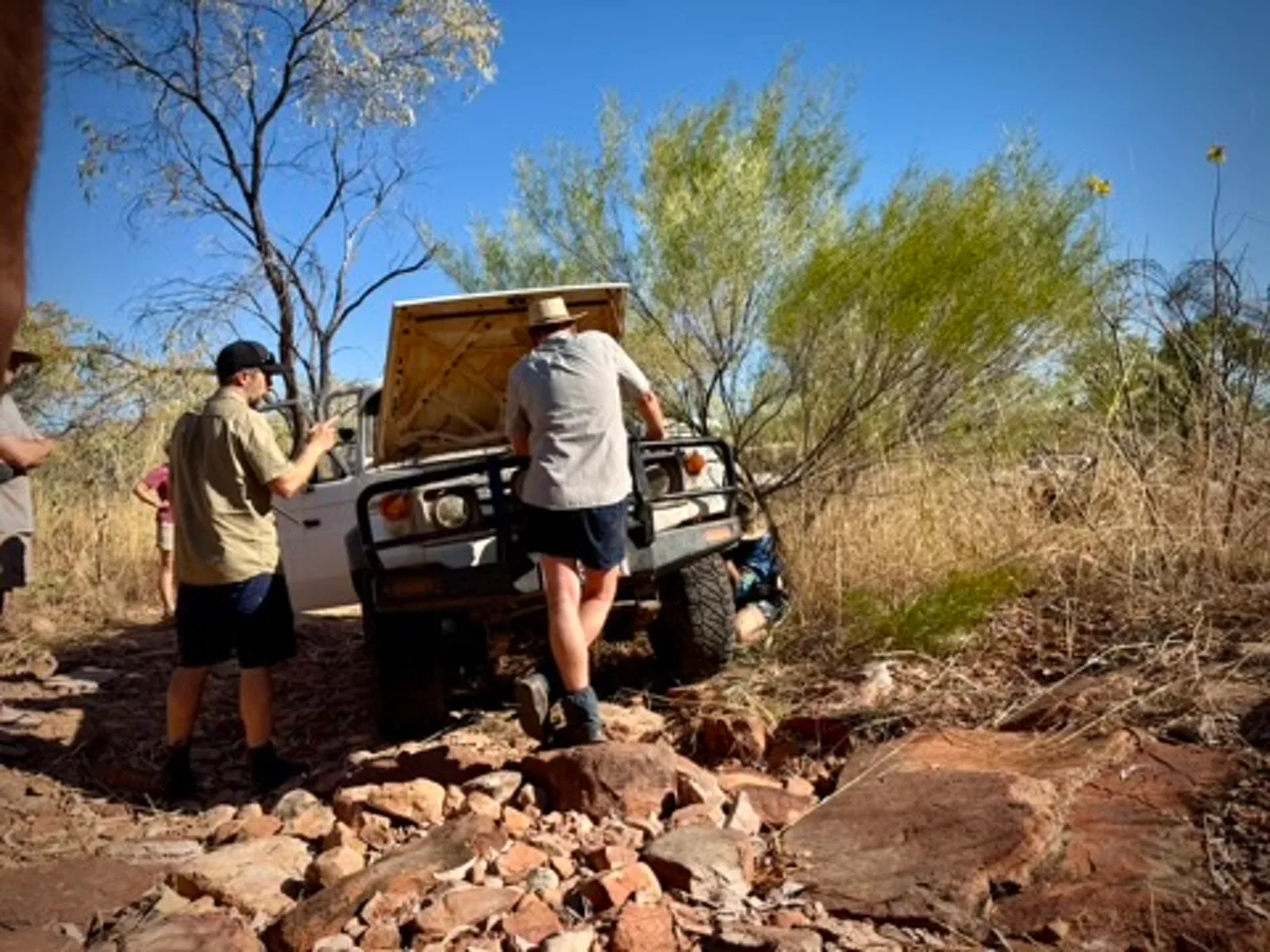
Before Dan headed home he showed me his problem — a 30 amp fuse on the cooling fan circuit was visibly cooking. Fan is rated at 14 amps, but it was drawing too much current. Either the fan had developed a fault or the fuse holder was just poor quality and arcing. He had a spare ready to bridge in if the temperature gauge climbed on the drive home.
That was Dan's last stretch of the trip. Before he left he told me about a campsite nearby — 4WD access only, well off the track.
The Secret Campsite
Four-wheel drive access only. Track in is a bit rough. Even over Easter, no one was there.
I'm not putting the location in writing.
What I will say: there's a rocky hill directly behind the campsite with an outcrop at the top. A few minutes walk, fairly steep. The views from up there are ridiculous. Good for a sunset or a sunrise if you want to make the effort.
I found a scorpion during cooking that night, right where I would have stepped if I'd been barefoot. Worth the reminder: no bare feet in camp at night.
Day Four: Pack Out
Rained during the night. Everything wet in the morning. I'd left the OnTap Roam outside — still working.
Waited an extra hour and a half to two hours hoping the weather would clear. It didn't. Only got worse. I packed up.
Out of the valley, up at 1,400 m — still completely socked in. Not a single patch of blue sky. Right call to leave.
Once I hit the bitumen, aired back up to 35 PSI using the MorrFlate and checked pressures on the iCheck TPMS. Still using both, trip after trip. The MorrFlate makes the air-up significantly faster when you're doing all four at once — that's a permanent kit change.
Tip on the iCheck: I don't bother with the counter nuts on the valve. Just thread on the sensor and put the rubber cap over it. Never lost one.
Four days away. $404 in fuel.
The full series — Part 1 through Part 4 — is on the AllOffRoad YouTube channel.